RBC’s James McGarragle says the retreat clears a headline overhang weighing on investor sentiment
Bombardier shares rose on Tuesday after US President Donald Trump stepped back from his September threat to bar the Montreal-based business jet maker from the American market.
Accounts of the move differ: Reuters reported a gain of 4 percent, CBC News reported a rise of $13.85 US, or about 4.5 percent, to a close of $325.32 US, and Bloomberg reported the shares rose as much as 2.6 percent in Toronto on Tuesday morning.
James McGarragle, an analyst at RBC Dominion Securities in Toronto, said in a note that the shift clears a drag on the stock.
“We view the removal of this regulatory uncertainty as positive for sentiment as it alleviates an important headline overhang for investors,” McGarragle said, in remarks carried by CBC News.
He told the outlet the threat had not had a “tangible impact” on demand for the jets among American customers over the past six weeks.
Trump signalled the reversal at a rally Monday in Park City, Kansas, near Wichita, where Bombardier operates its US headquarters, Bloomberg reported.
At the rally, Trump said he would help “a certain air company get themselves straightened away” after a phone call from Republican Senator Roger Marshall.
Trump said he had treated the company as Canadian, but said at the rally that its presence in Kansas changed his position, adding that he would “take care of those people” and the jobs.
Trump did not name Bombardier at the rally, according to Bloomberg.
Earlier the same day he told Kansas broadcaster 12 News, “We’re going to take care of Bombardier,” citing Marshall’s involvement, Reuters reported.
Marshall is facing a close re-election fight against Democrat Adam Hamilton in a state that has not elected a Democratic senator since 1932, CBC News reported.
Kansas lawmakers including Marshall called the White House after the September threat, according to Reuters.
The White House declined to comment to Reuters.
Reuters reported Bombardier employs about 3,500 people across the United States, with more than 40 percent of those jobs in Wichita.
The company pays more than US$2.5bn to some 2,800 American suppliers across 47 states each year, Bombardier told CBC News in September.
Final assembly of its Challenger and Global business jets takes place in Canada, while more than half of revenue comes from American customers.
Most of its planes carry at least 40 percent US content, and more than half the value of the Global 7500 derives from American parts, according to analysts cited by CBC News.
Cameron Doerksen, an analyst at National Bank, said last month that a ban would “undoubtedly” cause revenue and job losses at American parts producers and would be “massively disruptive” to American fleet operators awaiting deliveries, CBC News reported.
Bombardier announced a US$50m investment in Wichita last week and inaugurated a North American Learning Center at the site.
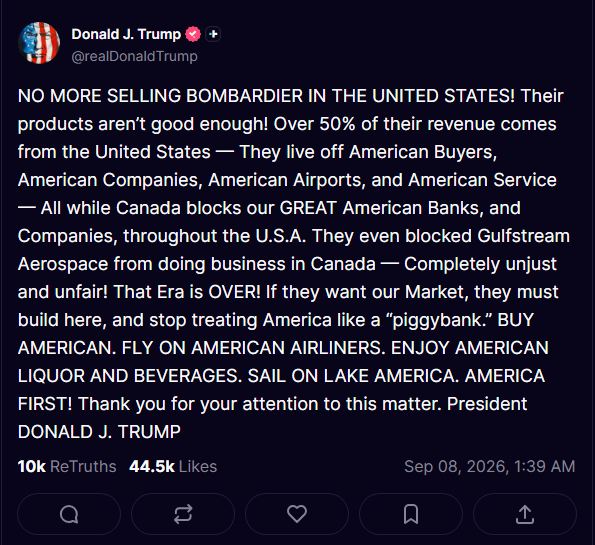
Source: @realDonaldTrump via Truth Social
Reuters reported it was not immediately clear how Trump could bar the jets from delivery to American customers, since the aircraft hold US Federal Aviation Administration approval.
A February threat to decertify Bombardier aircraft over a certification dispute involving Gulfstream Aerospace never materialized, with Transport Canada eventually approving the American-made jets.