Advisors should be watching change on the secondaries market now


Ask a private equity investor what worries them in 2026 and the answer is rarely returns on paper. It is cash.
The DPI drought
For most of its history, a PE fund bought companies, improved them and sold them within four or five years, sending cheques back to investors along the way. The measure that captures those cheques is DPI — distributions to paid-in capital. A DPI of 1.0x means investors have received back every dollar they contributed; anything above that is realized profit. Unlike TVPI (total value, including unrealized marks) or IRR, DPI cannot be revised later, because it counts cash rather than opinions about value.
By that measure the industry is in a drought. Bain reports that buyout funds distributed just 14% of net asset value (NAV) in 2025, after a decade-low 11% in 2024 — four consecutive years below 15%, against a 2014–17 average of 29%. Venture is worse: median DPI for 2019-vintage funds sits at 0.16x and for 2021 vintages at 0.05x, versus 1.68x for 2014 (PitchBook). Growth equity sits in between, sharing venture's dependence on IPOs and buyout's on leverage.
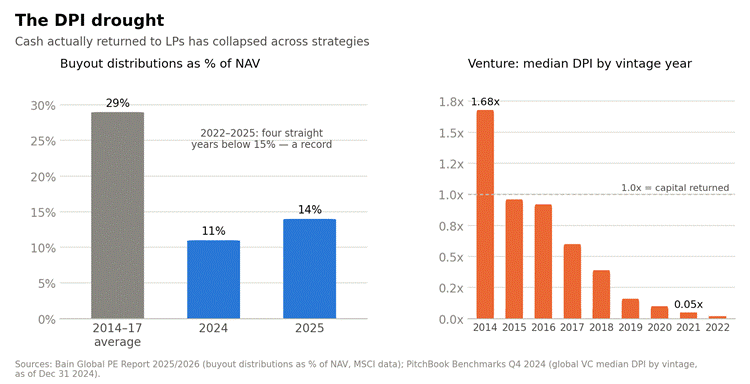
Figure 1. Distributions have fallen across strategies, most severely in venture.
“Clients rarely ask about IRR anymore,” says Darren Coleman, CFP, CIM, FCSI, TEP, founder of Portage Cross Border Wealth Management in Oakville, Ont. “They want to know when cash comes back and whether it will be there when they need it.”
The cause is a stalled exit market. Bain counts circa 32,000 unsold buyout-backed companies worth US$3.8 trillion, and the average hold at exit has stretched to about seven years from five or six in the 2010s. Canada is no exception: CVCA recorded no PE- or VC-backed IPOs in 2024 or 2025, and first-half 2026 exits were carried by two deals — the Apotex IPO and the Amica sale.
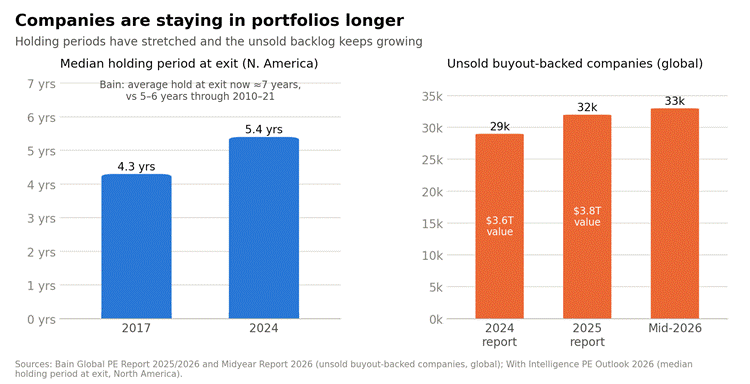
Figure 2. Longer holds and a growing backlog of unsold companies.
How managers have improvised
General partners (GPs) have responded with liquidity that is not quite an exit. Dividend recapitalizations — borrowing at the portfolio company to pay investors — reached US$72 billion in 2025, the second-highest year on record (PitchBook LCD). NAV loans, borrowed against the fund itself, have grown from a niche into a market 17Capital projects at US$145 billion by 2030. Distributions in kind — handing limited partners (LPs) shares instead of cash, most visibly Valor's US$8.5 billion SpaceX distribution this month — push the sale decision onto the investor. In private credit, circa 12% of loans now pay some interest in kind (PIK) rather than cash (FSB). And fund lives keep stretching: MSCI puts NAV in funds past their expected liquidation age at a record US$250 billion.
Secondaries step in
This is the gap secondaries fill. A secondary is simply the purchase of an existing private markets position rather than a commitment to a new blind-pool fund. It takes two forms:
- LP-led: an investor sells its stake in a fund, or a portfolio of stakes, to a buyer, usually at a discount to NAV. Buyout stakes cleared at circa 91% of NAV in the first half of 2026; venture at 79% (Jefferies).
- GP-led: the manager moves one or more companies into a new "continuation vehicle," giving existing investors the choice to cash out or roll over, with secondaries funds supplying the fresh capital.
Volume has tripled since 2019 to US$240 billion in 2025, and the first half of 2026 set a record at US$118 billion, with GP-led deals now the majority; continuation vehicles accounted for circa 14% of sponsor-backed exits. Capital has followed: Preqin puts secondaries AUM at US$522 billion, forecast to reach US$1.3 trillion by 2030, with 216 funds in market seeking US$115 billion. The market is also maturing beyond diversified flagships such as Ardian's US$30 billion ASF IX into infrastructure, private credit, real estate and venture specialists — and Toronto's Dawson Partners closed US$7.7 billion for portfolio financing last year.
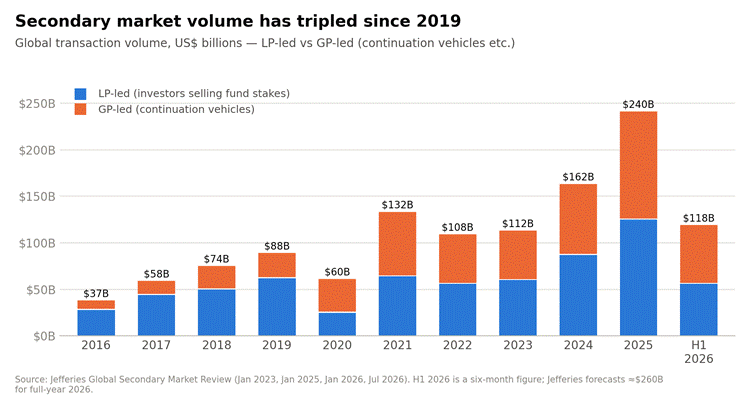
Figure 3. Secondary volume by deal type, 2016–H1 2026.
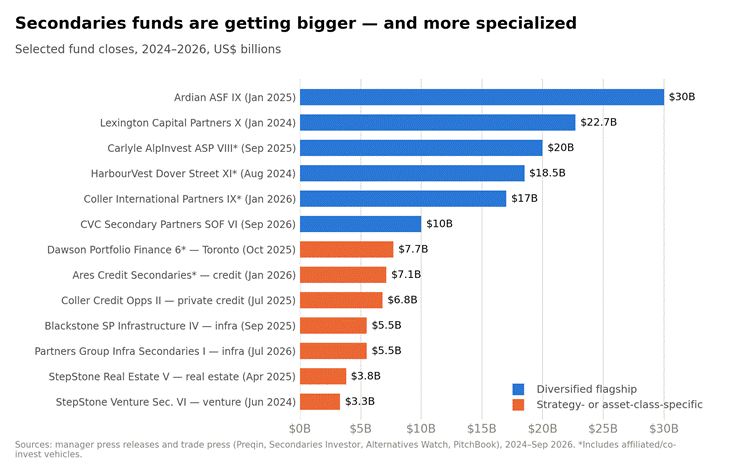
Figure 4. Flagship and specialist secondaries fund closes, 2024–2026.
What attracts secondary buyers?
For buyers, one of the main attractions is access to existing investments. They can evaluate the businesses already held, examine available financial information and assess the remaining path to a potential exit.
The timeline may also be shorter than that of a newly launched fund. If a portfolio company is approaching a sale, a secondary buyer may receive distributions sooner than an investor committing to a fund whose investments have yet to be selected. That possibility is not a guarantee: businesses can take longer to sell, require additional capital or underperform expectations.
Pricing is another consideration. Secondary interests may be offered at a discount to their reported net asset value (NAV), potentially giving buyers a margin of safety.
But the discount alone does not determine whether an investment is attractive. Reported valuations may lag changes in market conditions, and a discount may reflect genuine concerns about the portfolio, its financing or the time required to realize value. A buyer who pays less than reported NAV can still overpay if that NAV does not reflect what the underlying assets are ultimately worth.
Conversely, highly sought-after assets may command prices close to, or even above, reported NAV. The important question is whether the purchase price adequately compensates the buyer for the risks, costs and expected holding period.
Secondaries can also help investors construct portfolios across different managers, sectors and investment vintages. Rather than relying entirely on new commitments, buyers can select from existing fund interests or specific assets, depending on what is available and how much due diligence they can undertake.
These features help explain why secondaries may remain relevant even as traditional exit markets improve. They provide a way to manage private market exposure, not merely a response to delayed distributions.
What it means for advisors and family offices
For an advisor building a first PE allocation, secondaries flatten the J-curve: the buyer acquires seasoned, already-funded portfolios, so capital goes to work immediately, the discount provides day-one uplift, and distributions typically begin within one to three years rather than five to seven. For a mature allocation that is over-weight and under-distributing, the secondary market is the release valve: an LP can sell older fund stakes to rebalance, and a GP-led offer is a chance to take cash rather than roll. Evergreen secondaries vehicles now bring this to the wealth channel, in some cases with minimums of C$25,000; Jefferies estimates circa 41% of the US$113 billion that flowed into evergreen funds in 2025 went to secondaries.
“Lower minimums make secondaries easier to access, but easier to access doesn’t mean suitable,” says Coleman. “The starting point is the client’s liquidity needs, risk tolerance and time horizon, not the structure.”
Family offices have felt both sides. Their PE allocations have slipped from 22% to 17% (UBS), partly because distributions stopped funding new commitments, and nearly half of North American family offices now rank improving liquidity as a priority (RBC/Campden). They have become active sellers — circa 5–8% of LP-led volume — and 72% now invest in secondaries, up from 60% two years earlier (Goldman Sachs).
The exit problem will ease eventually. The market built to solve it will not go away.
The risks advisors should not overlook
For wealth-management professionals, the growth of secondaries raises an important distinction: a different route into private equity is not necessarily a less risky one.
First, NAV is an estimate, not a guaranteed sale price. Unlike publicly traded securities, private companies are not continuously priced in a liquid market. Reported valuations may not fully reflect changes in earnings, borrowing costs, financing conditions or the price a buyer would pay today.
Second, existing investments still carry business risk. Buyers need to assess the financial strength of the underlying companies, their debt, growth prospects and likely exit routes. A longer investment history may provide more information, but it does not remove uncertainty.
Third, liquidity remains limited. A secondary transaction may allow one investor to sell, but that does not mean the buyer can readily sell the interest again. Expected distributions can be delayed, and capital may remain committed for longer than anticipated.
Finally, GP-led transactions require particular attention to potential conflicts of interest. Existing investors may prioritize immediate liquidity, managers may want to retain assets, and incoming buyers may have different return expectations. Transparent disclosure, credible valuation processes, appropriate governance and fair treatment of investors are essential.
“A discount to NAV is a starting point for analysis, not a conclusion,” says Coleman. “We want to understand what’s behind the reported value and who benefits from the transaction.”
For advisors, the implication is not that secondaries should automatically be favoured over primary private equity investments. It is that the structure, pricing, underlying assets and investor’s liquidity needs must be considered together. The investment should be assessed on its own merits rather than on the appeal of a discount or the promise of a shorter holding period.
An evolution beyond the exit problem
Private equity’s exit difficulties have accelerated the growth of secondaries, but the market’s significance extends beyond the current cycle.
As private markets have expanded, investors and managers have needed more ways to manage ownership over time. Investors’ liquidity needs change; portfolio allocations must be adjusted; and some businesses require longer development periods than originally anticipated. A market that allows ownership interests to transfer can help accommodate those different circumstances.
“Private market holdings are easiest to manage when liquidity is planned around the client’s life stage, not discovered at the moment it’s needed,” says Coleman.
For sellers, secondaries can provide flexibility without waiting for every portfolio company to be sold. For buyers, they can create access to established investments at prices that may be attractive relative to the risks. For managers, continuation vehicles offer another option when retaining a business may make more sense than pursuing an immediate exit.
None of these outcomes is automatic. A transaction transfers ownership and risk; it does not eliminate the need for successful business performance or a viable eventual exit.
The broader lesson is that private equity liquidity is no longer determined solely by a manager’s ability to sell a portfolio company. It can also depend on whether another investor is willing to acquire an existing interest—and whether both parties can agree on a price that reflects the underlying value and uncertainty.
Private equity’s exit problem has not disappeared. But the growing secondary market is giving investors another way to respond to it, turning delayed liquidity for some into a potential investment opportunity for others.
Sources
Bain & Company, Global Private Equity Report 2025 and 2026; Private Equity Midyear Report 2026
PitchBook Benchmarks Q4 2024 (venture DPI by vintage); PitchBook LCD (dividend recaps, Sept 2026); PitchBook Q3 2026 Analyst Note, Private Equity's Zombie Problem
Cambridge Associates, US PE/VC Benchmark Commentary 1H 2025
Jefferies Global Secondary Market Review, January 2023, January 2025, January 2026 and July 2026
Preqin, Secondaries in 2026 and June 2026 fundraising release; MSCI Private Capital in Focus (2025, 2026)
17Capital/Oaktree NAV finance outlook (2025); Financial Stability Board, Vulnerabilities in Private Credit (May 2026)
With Intelligence, Private Equity Outlook 2026; CVCA Intelligence Q2 2026 and Year-End 2025 reports
UBS Global Family Office Report 2026; RBC/Campden Wealth North America Family Office Report 2025; Goldman Sachs Family Office Investment Insights 2025
Manager press releases: Ardian, Lexington, Carlyle AlpInvest, HarbourVest, Coller, CVC, Dawson Partners, Ares, Blackstone, Partners Group, StepStone