Chris Arthur, Founder and Principal of Bold Wealth Partners, explains why advisors should focus on tax-efficient exit planning, corporate structuring, and succession strategies now rather than waiting for regulatory changes that may still be years away


In the first part of this series I made the case that structure beats price: two advisors with identical practices, identical revenue, and identical client books can end up 40% to 50% apart after tax, purely because of how the sale is built and what corporate and trust scaffolding was put in place beforehand. A generation of Canadian advisors is at risk of leaving that gap on the table while they wait for regulators to hand them a solution.
The average dealer advisor in Canada is now 52.8 years old, and according to Investment Executive’s 2025 Advisors’ Report Card, only 51.8% have a documented succession plan in place. An Investment Planning Counsel study puts it more starkly: just 19% of advisors have a completed, detailed succession plan, and 80% admit they are hesitant about succession planning at all. An estimated $400B to $500B in client assets sit with independent advisors at or near retirement. And the rule many have been waiting for, the Canadian Investment Regulatory Organization’s Incorporated Approved Person (IAP) framework, finally arrived as a formal proposal on July 9, one day after the first part of this series ran. Some advisors are reading it as a reason to keep waiting.
My advice, after reading all of Rules Bulletin 26-0150, and after a long conversation last week with Jason Pereira, partner and senior financial planner at Woodgate Financial and one of the country’s most prominent planners: don’t.
The IAP proposal finally landed. Read the fine print.
On July 9, CIRO published Rules Bulletin 26-0150, the proposed rule amendments that would let any client-facing advisor conduct their business through a corporation approved as an Incorporated Approved Person, while phasing out the existing directed-commission option. Credit where due: it is a serious, detailed proposal, and it addresses a real inequity between mutual fund and investment dealer advisors. Pereira’s explanation of why it exists at all is worth hearing, because it resets expectations: “The MFDA and IIROC merged and created CIRO, and part of that mandate was the harmonization of the rulebook. You have a rulebook with two very different sets of rules, and that has to be reconciled. That is why we’re hearing about it.” In other words, this is rulebook housekeeping, not a succession plan. And for an advisor planning an exit, three things in the fine print matter more than the headline.
First, the timeline. The comment period runs to November 6. After that come CSA approval, amendments to National Instrument 31-103 and, in some provinces, to securities legislation itself; the CSA has not yet decided whether to create a new registration category for advisor corporations or exempt them from registration. CIRO is contemplating a further implementation period of 12 to 18 months once the legal groundwork is done, and no one has put a date on any of it. Investment Executive’s assessment: the changes are “likely still a long way off.” Realistically, you are looking at years, not quarters.
Second, the ownership constraints. As drafted, the corporation may have exactly one voting shareholder: you. You must also be the sole director. Non-voting shares are limited to you and family members who qualify as related persons under the Income Tax Act. No holding companies. No family trusts. No multi-advisor corporations. No sale of shares to an unlicensed buyer. There are sound oversight reasons for drawing the lines this way: the corporation exists because of the advisor’s relationship with a supervising dealer, and outside shareholders would add regulatory complexity for dealers and regulators alike. CIRO is consulting on whether to loosen some of these limits. The point for an exiting advisor is not that the constraints are wrong; it is that, as drafted, the IAP corporation is not designed to be a vehicle you sell. The family trust and the third-party share sale are exactly the two levers that drive the after-tax math below. Joe Millott, an M&A specialist writing in the Globe and Mail, put it plainly: if shares can’t be sold to an unlicensed buyer, incorporation risks being “a cosmetic improvement rather than a practical one” for succession.
Third, the tax outcome depends on your fact pattern. The rules here are settled, and Bulletin 26-0150 does not change them. It never mentions the Lifetime Capital Gains Exemption, QSBC status, or the small business deduction, because those turn on whether your business matches the fact patterns in the Income Tax Act, not on anything a dealer rule can grant. The CRA’s feedback to CIRO so far was, in CIRO’s words, “generally neutral”. CRA staff provided links to cases and website materials but not a ruling. And the personal services business risk is real: BDO’s analysis of the CRA’s recent compliance pilot found nearly a third of tested corporations were operating as PSBs, and PSB income is taxed at roughly 44.5% in Ontario with no small business deduction. Pereira’s read of the CRA’s neutrality fits the same theme: “We have more than 20 years of established precedent on how this works. When I heard the feedback was neutral, what I heard was CRA saying go read the existing rules.”
One more wrinkle: it is dealer-optional. Directed commissions have been permissible for mutual fund representatives since 1998, and entire channels never offered them. Nothing in this proposal obliges your dealer to offer the IAP either.
A rule can’t overrule your fact pattern
Even if every one of those items resolves in advisors’ favour, there is a harder constraint no CIRO rule can move: the Income Tax Act. Pereira, who is preparing a formal submission to CIRO on the proposal, is direct about it. “There are very standard guidelines as to what constitutes an independent contractor versus an employee, full stop,” he told me. “The fact that they allow for this to happen does not overrule CRA tax law and CRA findings. The fact pattern of your relationship with the dealer has to fit.”
The factors are the ones the CRA has applied for decades: who controls the work, who owns the tools and equipment, whose staff serve the clients, who carries the financial risk. For an advisor inside a bank brokerage, Pereira runs the checklist: “He collects a T4, not a T4A. He has all these employee benefits. He goes to an office that is provided for him. His staff are the bank’s staff. His computer and his equipment are the bank’s. He is checking all the boxes of an employee, full stop.” And the precedent is already decades old: “Not a single one of the mutual fund advisors at the big banks has been allowed to incorporate, and this has been an option available to mutual fund licensed advisors for decades. To think that this is going to be any different for them is just folly.”
His advice for those advisors does not depend on where they are in their career: “I don’t care if you’re three to five years from retirement or you’re starting out today. This isn’t for you. The fact pattern is the fact pattern.” The option that remains, in his words: “You want to be incorporated with your own business? Then leave that dealer and go to the independent side. That’s your option.”
None of that is a criticism of the banks; their integrated model is precisely why their client relationships are so durable. It is simply what the employee tests do. A compensation rule cannot turn an employment relationship into a business.
And Pereira is no cynic about the process. He has met with CIRO on this file and describes people who “want to get their job done right.” His view: “Decisions are made by those who show up. If no one puts forth the argument on how to properly structure it and it turns out wrong, no one should blame the regulator.” He is showing up. His submission will press CIRO to reflect the full range of business models on the independent side.
The channel that already solves this has been operating for decades. In the Portfolio Manager (ICPM) channel, advisors can own a corporation, generate qualifying active business income, structure the sale of their book as a share sale, and access the full range of QSBC and family-trust planning today. Advisors waiting for CIRO are watching their PM-channel peers complete clean, tax-efficient exits right now.
The math, revisited
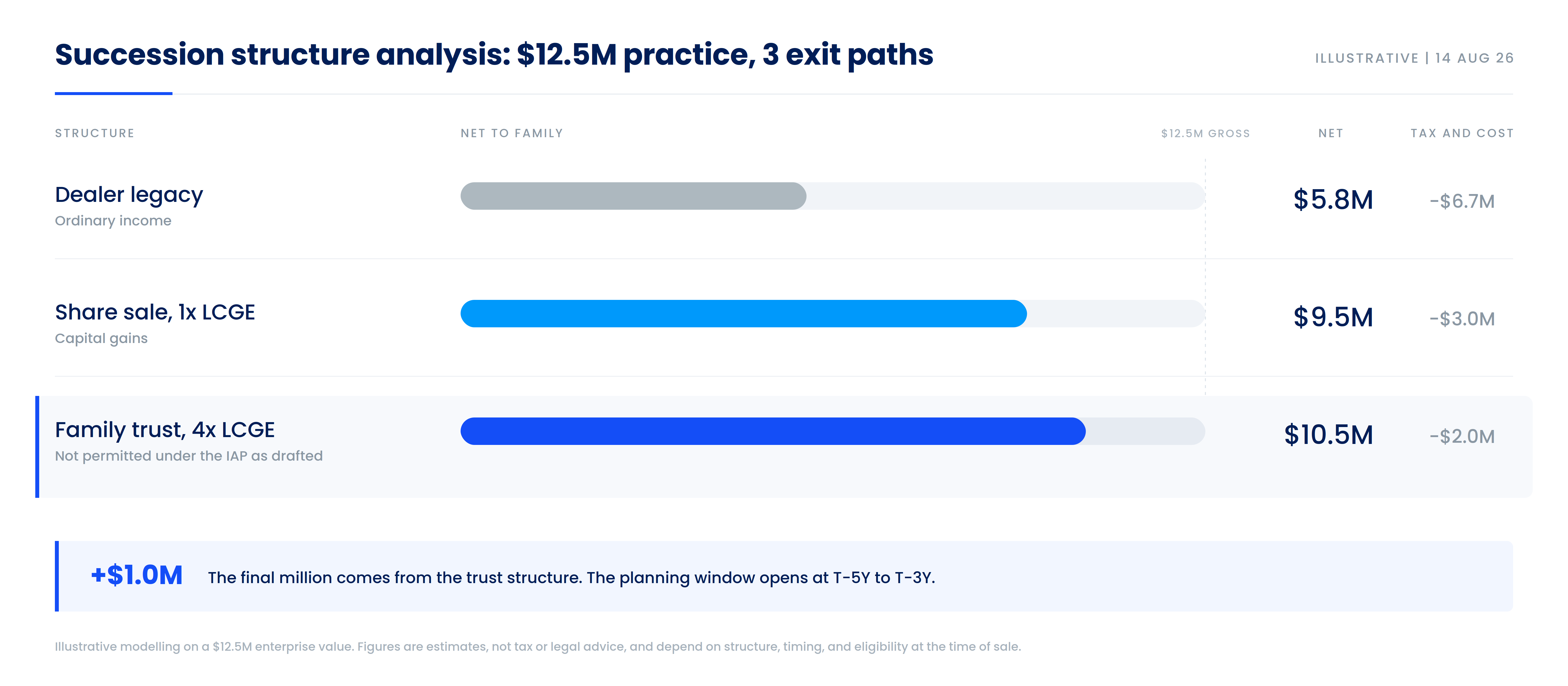
In Part 1 I walked through the same $12.5M practice sold three ways. Under a dealer legacy program, paid as ordinary income, the family nets roughly $5.8M. As an independent share sale using a single LCGE, roughly $9.5M. Through a family trust with four beneficiaries each using their own LCGE, roughly $10.5M. Those figures are illustrative and depend on the assumptions in the disclosures, but notice which structure adds the final million: the family trust, precisely the structure the IAP as drafted would not permit. And the planning has to start three to five years before a sale to satisfy the 24-month QSBC holding tests, the 90% active asset test at closing, and the TOSI, AMT, and 21-year trust rules.
How we approach it
Our model is built for exactly this. Because we operate in the Portfolio Manager channel, the planning I have described is not theoretical; it is how every transaction we do is structured. We acquire practices at strong multiples, typically 4 times gross revenue or better, through share-sale structures. To date, on completed transactions, we have achieved client retention above 95%, though past results are not a guide to future outcomes. And we take the responsibility of caring for your clients seriously, because your reputation continues to live through how they are treated after you have stepped away.
My view is simple: you should keep what you built. Captive-dealer platforms are often structured so that most of your upside is recharacterized as taxable income. That is a reasonable business for the dealer; it is a poor outcome for the retiring advisor. A stronger multiple, a share-sale structure, and LCGE plus family-trust planning can, depending on circumstances, change the result meaningfully. On mid-sized practices, the after-tax difference may run into the millions. On larger, multi-advisor teams, it may reach the tens of millions.
Don’t wait. Plan.
If you are looking at a three- to five-year exit, my recommendation is direct: do not wait for the regulatory environment to be perfect. The IAP may eventually arrive, and the ownership constraints may eventually loosen; the consultation runs to November 6 and I encourage every advisor to read the bulletin and comment. But while you wait through comment periods, legislative amendments in thirteen jurisdictions, and a 12-to-18-month implementation window, you are being paid in income rather than capital. I have watched advisors postpone an exit by two or three years hoping for clarity, only to see markets move, multiples compress, and their best years of client value benefit the dealer rather than their own family.
The practical steps are the ones I set out in Part 1: get a defensible valuation from a Chartered Business Valuator, audit what your channel actually allows at exit, set up your corporate and trust structures three to five years before a sale, and compare every offer on an after-tax basis, not on the headline multiple.
On most exits I see, the lower headline number wins after tax, and by a wide margin. The advisors who work this out before they sell keep far more of what they built. The IAP, whenever it lands and whatever it finally permits, will not change that arithmetic. Planning will.
About Bold Wealth
Bold Wealth is a Canadian Portfolio Manager (ICPM) firm acquiring and partnering with retiring and growing advisor practices through share-sale structures. The firm typically pays 4 times gross revenue for practices it acquires and has consistently achieved client retention rates above 95% on completed transactions.
Free succession consultation
Bold Wealth is offering retiring advisors a complimentary succession-structure review and after-tax modelling consultation with a specialized CPA. Whether you’re five years from exit or just starting to think about it, we’ll walk through your channel, your structure, and what the after-tax math looks like on your specific practice. Contact Bold’s CEO Chris Arthur directly at chris@boldwealth.ca or visit boldwealth.ca to book a call.
Disclosures
General. This article is information only, not investment, tax, or legal advice. Chris Arthur is not a CPA or lawyer; consult your own qualified tax, legal, and registered professionals. Tax rates, the inclusion rate, and the LCGE amount cited are current as of July 2026 and subject to legislative change. The complimentary consultation is preliminary, not advice.
Promotional; issuer interest. This is promotional content. Bold Wealth Partners is a prospective purchaser of advisor practices with a financial interest in the share-sale transactions described; it is not independent, impartial, or personalized advice. Obtain independent advice before acting.
Illustrative figures. The three scenarios and the captive-channel example (one advisor conversation) are illustrative only. Outcomes depend on individual circumstances, including province and whether the corporation and trust satisfy the QSBC and active-business-asset tests. They assume an Ontario vendor at the 53.53% top rate, a nil/nominal cost base, a 50% inclusion rate, the indexed 2026 LCGE, and, in the third, four beneficiaries each with a full LCGE; they exclude AMT (which can materially reduce the LCGE benefit), TOSI, and fees. Figures are in Canadian dollars.
Regulatory proposals. Descriptions of CIRO Rules Bulletin 26-0150 reflect the proposal as published July 9, 2026. It is a proposal only, subject to change through the comment, CSA approval, and legislative process, and its final form, tax treatment, and availability are not assured.
Third-party views. Quotes from Jason Pereira are from a July 30, 2026 interview, lightly edited for length and clarity. His views are his own; he was not compensated for the interview and his participation is not an endorsement of Bold Wealth or its services.
Client retention. The above-95% figure reflects the best available data across all completed Bold Wealth and Chris Arthur acquisitions, measured over the 12-month post-close period (or longest available if shorter).
Forward-looking. Forward-looking statements reflect current views; actual conditions may differ materially.
Registration. Bold Wealth Partners is registered as a Portfolio Manager and Investment Fund Manager; principal regulator is the Ontario Securities Commission (OSC).
Past or hypothetical results are not indicative of future outcomes.