With yields back above 5%, advisors can once again look to high-quality bonds for income, diversification and a stronger core allocation

This article was produced in partnership with Vanguard Investments Canada
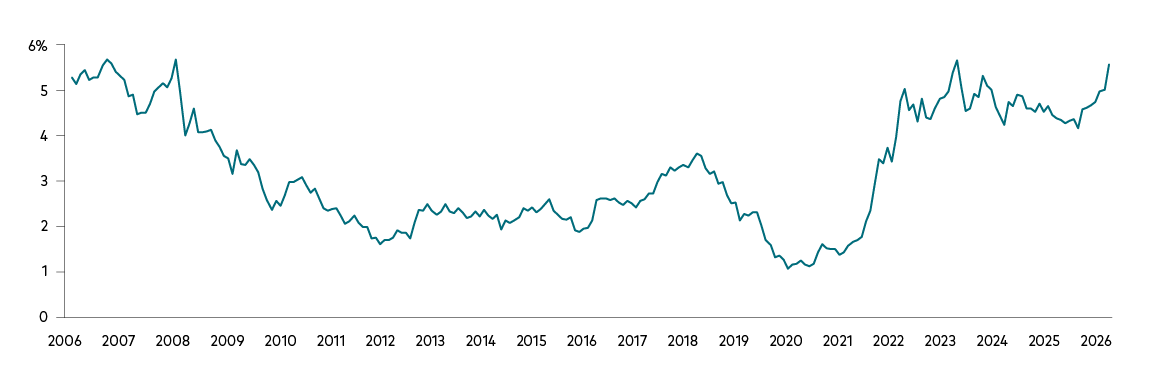
In the decade following the Global Financial Crisis, investors faced a difficult trade-off in fixed income: accept the limited income and return potential available from broad investment-grade bonds or take on additional risk in pursuit of higher yields. By 2020, that trade-off became acute, with the Bloomberg U.S. Aggregate Bond Index yielding close to 1%.
Today, the picture is dramatically different. The Bloomberg U.S. Aggregate Bond Index now yields more than 5% and investors no longer need to move down the credit spectrum in search of yields. Higher starting yields matter because they have historically been closely related to subsequent longer-term fixed income returns and crucially provide more income to help offset price volatility.
For Canadian advisors, this creates an opportunity to reconsider bond allocations, with the asset class once again offering many of its traditional characteristics within a balanced portfolio.
Chart 1: Yield to worst of the Bloomberg U.S. Aggregate Bond Index
Source: Bloomberg L.P., as of September 30, 2026.
2022 in context
Any conversation about bonds eventually returns to 2022, when the Bloomberg U.S. Aggregate Bond Index experienced the worst calendar-year declines in its history. The experience challenged long-held assumptions about the role of bonds in a portfolio.
The bond market entered that year with yields of roughly 1.75%, near their lowest level in modern history, leaving investors with little income to offset the effect of rapidly rising interest rates. With yields now above 5%, investors are starting from a much stronger position, with significantly more income available to help absorb market volatility.
History also provides useful perspective. Over the past five decades, the Bloomberg U.S. Aggregate Bond Index has experienced relatively few calendar years with negative returns. While bonds are not immune to losses, 2022 has historically been the exception rather than the rule on the magnitude of decline.
Chart 2: Worst calendar year losses for the Bloomberg U.S. Aggregate Bond Index
|
Year |
Return (%) |
|---|---|
|
2022 |
-13.01 |
|
1994 |
-2.92 |
|
2013 |
-2.02 |
|
2021 |
-1.54 |
|
1999 |
-0.82 |
Source: Morningstar Research Inc., as of December 31, 2025. Past performance is no guarantee of future returns. The performance of an index is not an exact representation of any particular investment, as you cannot invest directly in an index. Results will vary for other time periods. Base currency: USD.
The role of bonds as a diversifier for multi-asset portfolios
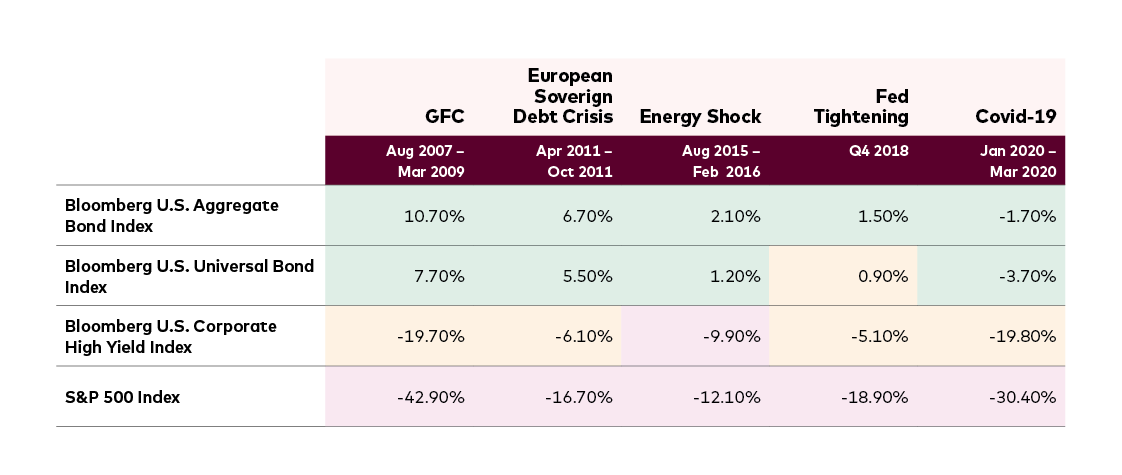
We tend to focus on recent performance, but periods such as 2008 and 2020 serve as reminders of the important diversification benefits that high-quality bonds can provide. The chart below highlights how they performed during some of the most challenging environments for equities and high-yield bonds.
Chart 3: Total returns of major bond indexes through down markets for equities and credit
Past performance is no guarantee of future returns. The performance of an index is not an exact representation of any particular investment, as you cannot invest directly in an index. Results will vary for other time periods. Base currency: USD. Source: YCharts as of August 18, 2026. Dates for GFC: 7/31/2007-3/31/2009; Dates for European Sov Debt Crisis: 4/1/2011-10/3/2011; Dates for Energy shock 8/17/2015-2/11/2016; Dates for Covid-19: 2/24/2020-3/23/2020.
Multisector and higher-yielding fixed income strategies have been popular with advisors in recent years, a period that has generally been supportive of credit-oriented assets as spreads tightened and risk assets performed well. However, bonds can serve different roles within a portfolio.
When maximizing income is not the primary objective, a core-plus strategy can provide a broader opportunity set than traditional core bonds while maintaining more conservative credit-risk parameters than many multisector or high-yield strategies. For advisors, the key consideration is whether that flexibility can be added without losing the high-quality characteristics that support diversification.
Introducing VCOR: A Global Core-Plus Fixed Income Solution
To help advisors navigate an increasingly complex fixed income landscape, Vanguard recently launched Vanguard Global Core Plus Bond ETF (VCOR), bringing Vanguard's active fixed income expertise to Canada as an ETF for the first time. The actively managed strategy combines a core allocation to investment-grade bonds with selective exposure to global credit, high-yield, and emerging market debt.
The “core” component is designed to provide a high-quality foundation for diversification during equity market stress, while the “plus” component expands opportunities for income and total return through exposure beyond traditional core bond benchmarks.
With a maximum allocation limit of 25% to below-investment-grade securities, the strategy occupies a middle ground between traditional core bond portfolios and potentially higher-risk multisector approaches. The result is a portfolio designed to balance equity diversification, income generation, and long-term total return potential, making it a compelling core fixed income allocation within a broader multi-asset portfolio.
The fixed income environment has changed considerably since the low-yield conditions that preceded 2022. Higher starting yields do not eliminate price volatility of bonds, but they provide investors with more income and a stronger foundation from which to pursue long-term returns. VCOR is designed around that objective, combining a high-quality core with measured flexibility to access opportunities across global fixed income markets.
Disclaimer:
Commissions, management fees, and expenses all may be associated with investment funds. Investment objectives, risks, fees, expenses, and other important information are contained in the prospectus; please read it before investing. Investment funds are not guaranteed, their values change frequently, and past performance may not be repeated. Vanguard funds are managed by Vanguard Investments Canada Inc. and are available across Canada through registered dealers.
Publication date: October 2026
The information contained in this material may be subject to change without notice and may not represent the views and/or opinions of Vanguard Investments Canada Inc.
The management fee is equal to the fee paid by the Vanguard fund to Vanguard Investments Canada Inc. and does not include applicable taxes or other fees and expenses of the Vanguard fund. (For any Vanguard fund which invests in underlying Vanguard fund(s), there shall be no duplication of management fees chargeable in connection with the Vanguard fund and its investment in the Vanguard fund(s).
Certain statements contained in this material may be considered "forward-looking information" which may be material, involve risks, uncertainties or other assumptions and there is no guarantee that actual results will not differ significantly from those expressed in or implied by these statements. Factors include, but are not limited to, general global financial market conditions, interest and foreign exchange rates, economic and political factors, competition, legal or regulatory changes and catastrophic events. Any predictions, projections, estimates or forecasts should be construed as general investment or market information and no representation is being made that any investor will, or is likely to, achieve returns similar to those mentioned herein.
While the information contained in this material has been compiled from proprietary and non-proprietary sources believed to be reliable, no representation or warranty, express or implied, is made by The Vanguard Group, Inc., its subsidiaries or affiliates, or any other person (collectively, "The Vanguard Group") as to its accuracy, completeness, timeliness or reliability. The Vanguard Group takes no responsibility for any errors and omissions contained herein and accepts no liability whatsoever for any loss arising from any use of, or reliance on, this material.
This material is not a recommendation, offer or solicitation to buy or sell any security, including any security of any investment fund or any other financial instrument. The information contained in this material is not investment advice and is not tailored to the needs or circumstances of any investor, nor does the information constitute business, financial, tax, legal, regulatory, accounting or any other advice.
The information contained in this material may not be specific to the context of the Canadian capital markets and may contain data and analysis specific to non-Canadian markets and products.
All investments are subject to risk, including the possible loss of principal. Foreign investing involves additional risks, including currency fluctuations and political uncertainty.
The information contained in this material is for informational purposes only and should not be used as the basis of any investment recommendation. Investors should consult a financial, tax and/or other professional advisor for information applicable to their specific situation.
In this material, references to "Vanguard" are provided for convenience only and may refer to, where applicable, only The Vanguard Group, Inc., and/or may include its subsidiaries or affiliates, including Vanguard Investments Canada Inc.